本文发布于301 天前,其中的信息可能已经过时,如有错误请发送邮件到supper@vcclient.xyz
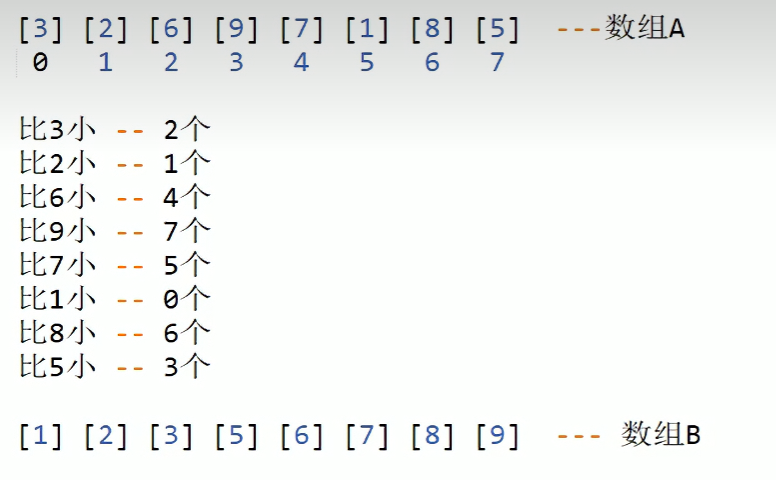
统计数组A中的比每个元素小的元素个数,并把该个数作为数组B的下标
/******************************************************************************
*
*   file name : 计数排序
*   author    : Wzy
*   data      : 2025/12/15
*   function  : 统计数组A中的比每个元素小的元素个数,并把该个数作为数组B的下标
*   note      : None
*
*   copyRight  (c)  2025    17630246607@163.com   All Right Reseverd
* ****************************************************************************/


#include <stdio.h>
#include <string.h>
#include <stdlib.h>
#include <stdbool.h>


/******************************************************************************
*
*   func name    : CountSort
*   function     : 实现计数排序
*   argument     :
* 					@A[]:待统计的数组
* 					@size:数组中元素的个数
*   				@B[]:新数组
*   retval       : None
*   author       : Wzy
*   date         : 2025/12/15
*   note         : None
*
* ****************************************************************************/
void CountSort(int A[],int B[],int size)
{
	int cnt = 0; //记录个数

	for (int n = 0; n < size; ++n)
	{
		cnt = 0; //计数器清0;

		//n作为数组A的元素的下标
		for (int i = 0; i < size; ++i)
		{
			if (A[i] < A[n]) //A[n]为当前元素,A[i]是数组中的所有元素
			{
				cnt ++;
			}
		}

	B[cnt] = A[n];

	}
}


int main(int argc, char const *argv[])
{

    //定义一个整形数组存储10个整数
	int A[11] = {14,23,12,5,8,3,9,10,33,6,11};
	int B[11] = {0};

	printf("排序前整数序列\n");
	for (int i = 0; i <sizeof(A)/sizeof(A[0]); ++i)
	{
		printf("%d ",A[i]);
	}

	printf("\n");

	CountSort(A,B,sizeof(A)/sizeof(A[0]));

	printf("排序后整数序列\n");
	for (int i = 0; i <sizeof(B)/sizeof(B[0]); ++i)
	{
		printf("%d ",B[i]);
	}

	printf("\n");

	return 0;
}
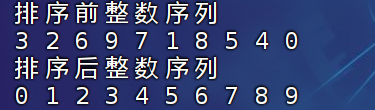
测试结果